
Advanced Damage Prevention for Ticketed and Unticketed Excavation Risk
Satellite-Enhanced Excavation Intelligence
KartaSoft gives damage-prevention teams independent visibility into both declared and undeclared excavation activity before incidents occur. The platform combines 811 ticket risk, satellite-detected ground disturbance, asset proximity, historical damage patterns, and consequence scoring into one prioritized queue for field action.
Surface candidate indications of unreported activity near pipeline corridors.
Prioritize known tickets by consequence.
Escalate the highest-risk threats before they become damages.
-1.svg)
Independently Validated
Used by Fortune 500 Companies
Supports Regulatory and Audit Review
Physics-Informed Methodology
The excavation risk your team cannot see may be the one that matters most
.svg)
Damage-prevention programs were designed around declared excavations and procedural compliance. Ticketing systems, patrols, locate workflows, and alarms remain essential.
But they were not built to answer every risk question operators face today.
- Which ticketed jobs expose the most critical assets?
- Which parts of a dig polygon are actually risky?
- Where is ground disturbance occurring with no 811 ticket?
- Which corridor threats deserve field review today?
- Which detections are credible enough for high-resolution follow-up?
KartaSoft adds an independent analytical and observation layer over existing damage-prevention workflows without replacing them.
Different signals. One consequence-ranked risk queue.
No other platform detects corridor threats like this
Many no-call analytics approaches rely on proxy signals such as ticket history, permit data, contractor behavior, and construction density. These are useful for long-term prevention and outreach.
KartaSoft goes further by looking for physical evidence of activity near the corridor.
| Typical no-call analytics | KartaSoft no-call intelligence | |
|---|---|---|
| Starting point | Tickets, permits, contractor history, construction density | Satellite-detected ground disturbance near pipeline corridors |
| Main method | Predict where no-calls are more likely | Observe candidate surface-change signals and characterize relative asset exposure |
| Evidence type | Proxy signals | Observed surface-change signal plus asset context |
| Action | Outreach campaign, education, targeted monitoring | Escalation queue for credible corridor threats |
| Escalation logic | Area or contractor risk | Detection confidence, asset proximity, consequence, repeat change |
| Best use | Long-term prevention | Early warning and field triage |
How it works
Ingest
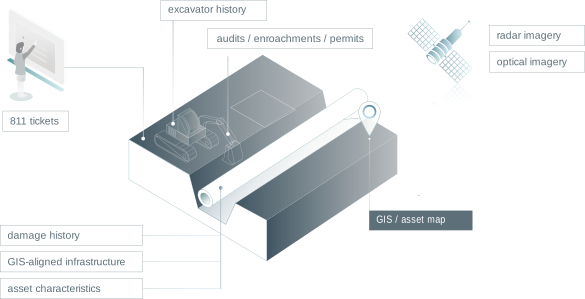
Bring together ticket data, pipeline GIS, asset characteristics, corridor geometry, historical damage records, audit outcomes, excavator history, critical facility proximity, encroachment history, satellite imagery, and field observations.
Detect
Identify candidate ground disturbance near pipeline corridors using radar and optical imagery.
Rank
Ticketed and unticketed activity is scored against the same consequence model, including asset proximity, severity, detection confidence, repeat change, location sensitivity, and historical risk.
Escalate
The highest-risk items are routed into a ranked information queue for field review, high-resolution follow-up, supervisor escalation, excavator outreach, targeted patrol, or intervention.
.svg)
Learn
Confirmed outcomes, false positives, field notes, and intervention results feed back into the model so risk targeting improves over time.
One platform for declared and undeclared excavation activity
Excavation risk does not arrive through one channel.
Some activity appears in the 811 workflow.
Some appears in permits.
Some becomes visible only as physical change near the corridor.
KartaSoft brings these signals into one operating picture.
-1.svg)
*Example only, output is configured to match customer preferences
| What KartaSoft does | Operational output | |
|---|---|---|
| 811 tickets | Scores known excavation activity by likelihood, severity, and asset consequence | Prioritized inspection and intervention list |
| Ticket geometry | Identifies within-polygon variation in risk | Sub-ticket geospatial heat mapping |
| Excavator and work history | Applies behavioral risk weighting from past outcomes | More precise prioritization of repeat-risk patterns |
| Satellite detections | Flags candidate unticketed ground disturbance near pipeline corridors | Escalation queue for credible unreported activity |
| Asset and GIS data | Adds proximity, criticality, and consequence context | Risk ranking based on what is actually exposed |
| Field outcomes | Captures findings, confirmations, false positives, and interventions | Continuous improvement of risk targeting |
Risk Management and Damage Prevention for Excavation Activities
A unified integrated risk picture
KartaSoft adds an independent analytical layer over existing damage prevention workflows without replacing them.
It operates across both declared and undeclared excavation simultaneously.
1. Excavation Risk Score for Ticketed Activities
KartaSoft helps damage-prevention teams focus on the tickets most likely to create material asset exposure.
Core capabilities include:
- Real-time scoring on likelihood of strike and severity
- Sub-ticket geospatial risk heat mapping
- Behavioural risk weighting by excavator history
- Network-wide prioritization queue surfaced in GIS
- Interpretable reason codes
→ This helps teams move from broad ticket review to targeted field intervention.
2. Satellite Detection for Unticketed Activities
KartaSoft monitors pipeline corridors for candidate ground disturbance that may never enter the 811 workflow.
Core capabilities include:
- Satellite-detected ground disturbance near pipeline corridors
- Radar and optical imagery, Sentinel-1 and Sentinel-2
- Asset proximity risk scoring for each candidate
- High-resolution follow-up on most credible detections
- Early escalation flags before SCADA or physical alarm
→ This gives operators a practical additional situational awareness layer for no-call excavation risk.
The model is trained on the operator's own historical ticket and damage data — excavator history, pipeline characteristics, audit records, critical facility proximity, and encroachment history. It is engineered as a non-intrusive overlay on existing GIS and asset management environments.
A Defensible Economic Model for Excavation Risk
KartaSoft Excavation Intelligence reduces excavation-driven incidents, financial loss, and regulatory exposure by shifting intervention earlier and targeting effort where risk is material.
1. Operational Cost Stability
Earlier intervention shifts cost curves
By identifying elevated excavation risk before SCADA alarms or asset damage:
- Emergency repairs shift to planned work
- Crew overtime and call-outs are reduced
- Damage is addressed before escalation
Economic Impact
Economic Impact
2. Field Efficiency & Workforce Safety
Risk-based prioritization reduces wasted field effort
Today, many excavation alerts lack asset-specific risk context, forcing field teams to investigate broadly.
KartaSoft ranks excavation activity by actual asset exposure and consequence, focusing crews only where intervention materially reduces risk.
3. Recovery Economics & Claims Defensibility
Evidence strengthens third-party cost recovery
Where damage occurs, the system provides time-stamped, spatial evidence to support attribution and claims, all without changing existing recovery processes.
Economic Impact
Economic Impact
4. Capital Efficiency & Asset Strategy
Persistent excavation pressure informs capital decisions
Repeated excavation pressure creates a hidden degradation risk. By identifying recurring exposure patterns:
- Capital replacement can be targeted
- Asset renewal is prioritised where risk persists
- Deferred CapEx decisions carry higher confidence
Outputs are auditable, repeatable, and suitable for regulatory and internal review
Review excavation risk exposure in your network
Confidential, non-binding discussion focused on risk diligence