KartaSoft Capital Prioritization for Water & Wastewater Networks
Put finite capital where it retires the most risk
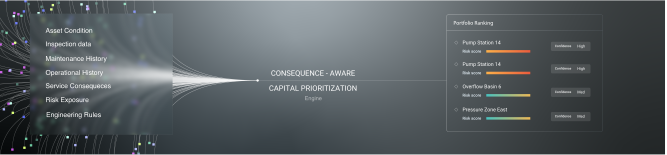
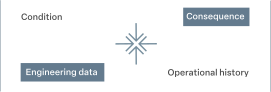
Aging assets, reactive work, growth pressure, and regulatory exposure all compete for the same capital. KartaSoft helps utilities rank where investment will create the greatest reduction in operational and regulatory risk by connecting condition, consequence, operational history, and engineering context into one defensible prioritization model.
Risk-based capital allocation
Consequence-based prioritization
Maintenance-to-renewal evidence
Explainable portfolio scoring
Every asset has a funding case
Not every investment reduces the same risk
Water and wastewater utilities are under constant pressure to do more with finite capital.
Asset
Aging mains, pump stations, overflow exposure, service reliability, growth needs, resilience programs, and compliance obligations all compete for the same investment pool.
Challenge
The challenge has moved beyond understanding the state of aging assets into proving which investments should move first because they reduce the greatest operational, service, and regulatory risk.
Separate base data
When asset condition, maintenance history, consequence, inspection data, operational events, and engineering judgement live in separate systems, prioritization becomes inconsistent.
Inconsistent prioritization
Projects rise because they are visible, urgent or falimilar while higher-consequence risks can remain underfunded.
A defensible model for deciding what to inspect, maintain, renew, defer, or redesign
KartaSoft helps utilities build an explainable capital prioritization model from existing asset and operational evidence
Built around the capital decisions utilities need to defend
Where should we
invest next?
Prioritize capital towards assets and programmes with the clearest operational, compliance, and service risk payoff.
Strengthen confidence that limited CapEx is being directed where it can create the greatest reduction in portfolio risk.
Maintenance demand
Field history
Consequence
Inspection needs
Service impact
Which assets should move first?
For inspection, maintenance, renewal, monitoring, or escalation toward capital planning.
How do we make the model defensible?
Transparent scoring logic
that can be inspected, explained, refined, and validated against real asset programs
How does this improve TotEx?
Identify where renewal, compliance, resilience, growth, and operational programs can be sequenced, bundled, deferred, advanced, or redesigned to reduce duplicated interventions and repeated disruption.
FAQs
Good. KartaSoft is not positioned as a system replacement. It is a prioritization layer that helps connect asset, operational, consequence, and engineering evidence so the capital decision logic is clearer and easier to defend
Incomplete data is part of the prioritization problem. The model should show where confidence is strong, where assumptions are being used, and where targeted inspection or data collection would materially improve the decision.
Capital prioritization needs transparency. KartaSoft makes the ranking drivers visible so engineering teams can inspect the logic, executives can understand the trade-offs, and governance teams can defend why one investment moves ahead of another.
That is why the evidence path matters. Recurring maintenance burden, field constraints, service instability, and high-consequence operational risk can help show when an asset should move from routine response into renewal or broader capital consideration.
Outputs are auditable, repeatable, and suitable for regulatory and internal review
See where your next capital dollar reduces the most risk
Start with one portfolio question. KartaSoft will help assess whether your existing asset, maintenance, operational, and consequence data is enough to build a transparent prioritization model and identify the investments most likely to reduce operational and regulatory exposure.