 Why Excavation Damage Remains a Pipeline Safety Challenge
Pipeline damage prevention has changed substantially over time.
One-call systems improved coordination between operators, excavators and locators. Digital workflows made excavation activity easier to manage. GIS added spatial and asset context. More recently, predictive approaches have created new ways to identify where attention may be warranted.
These capabilities represent genuine progress. Each has strengthened what teams responsible for protecting pipeline infrastructure can see, manage and evaluate.
Excavation damage remains a significant pipeline safety concern.
Understanding why requires looking at what each capability helps operators understand and what decision remains once those capabilities are in place.
Why Does Excavation Damage Remain a Pipeline Safety Concern?
The scale and impact of excavation damage remain substantial. In its April 2026 Advisory Bulletin, Pipeline and Hazardous Materials Safety Administration (PHMSA) reported that since 2005 there have been more than 875 excavation-related pipeline incidents and accidents, resulting in 40 fatalities, 166 serious injuries and approximately $322 million in property damage.
The challenge persists alongside meaningful improvements in prevention. PHMSA has reported improvements in excavation safety and greater awareness of 811, while continued infrastructure development creates more activity around buried assets.
The scale is also visible in recent damage-prevention data. In 2025, PHMSA reported 85,606 excavation damages to gas distribution facilities across 35,813,977 excavation tickets nationwide. Excavator-related issues were the most frequently reported root cause, accounting for approximately 39.3% of those damages.
These figures relate specifically to gas distribution facilities rather than the entire pipeline sector. They illustrate the volume of activity that damage prevention systems may need to be managed.
Why is excavation damage difficult to manage across a pipeline network?
Pipeline operators can face excavation activity across many locations and operating environments.
Some activity enters established one-call and damage-prevention workflows. Other context may come from digital systems, geospatial data and additional monitoring or assessment capabilities.
Inspection capacity, locating resources and field personnel remain finite. KartaSoft's Category Paper identifies this constraint directly: activity around critical infrastructure continues to grow while the resources available to investigate and intervene remain limited.
Damage prevention at network scale therefore includes a prioritization problem: how can teams use what they know to focus on finite resources effectively?
The evolution of damage prevention helps explain how the industry arrived at that question.
How Has Pipeline Excavation Damage Prevention Evolved?
Damage prevention has developed through capabilities that build on one another.
One-call systems remain an essential coordination mechanism. Digital workflows, GIS and predictive approaches add increasingly useful context for assessing excavation activity.
KartaSoft's Category Paper traces this evolution from manual processes through 811 ecosystems, digital workflows, GIS and visibility, and prediction and prioritization.
How do 811 and one-call systems help prevent excavation damage?
One-call systems created a structured mechanism for communication before excavation begins.
In the United States, 811 allows planned excavation activity to be communicated so underground facilities can be located and relevant parties coordinated before work proceeds.
That role remains fundamental. PHMSA's 2026 Advisory Bulletin continues to emphasize accurate and timely locating, adherence to Common Ground Alliance best practices and proactive coordination with excavators.
Within the Category Paper's evolution, 811 provides the coordination and notification on which later capabilities can build.
What have digital workflows added to damage prevention?
Digital workflows provide a more structured way to manage excavation activity and field coordination.
Ticket details and related records can be handled through digital processes rather than relying solely on manual workflows and local knowledge. This gives teams a more consistent basis for reviewing excavation activity across a network and connecting it with other relevant context.
How does GIS support pipeline damage prevention?
GIS adds spatial and asset context.
An excavation notification becomes more useful when teams can understand where the activity sits in relation to buried pipeline assets and the surrounding network.
The Category Paper describes this capability as adding “spatial context and asset awareness.”
The decision has now progressed from knowing that excavation activity exists to understanding where it is occurring relative to the infrastructure being protected.
Can predictive approaches identify where excavation damage may be more likely?
Predictive approaches can add a probability-oriented view of where third-party damage to pipelines may be more likely.
This adds something different from notification or spatial visibility: it can help teams distinguish where risk may warrant closer attention.
The Category Paper places prediction and prioritization after 811, digital workflows and GIS, supporting risk-based triage and resource focus.
Once teams have a clearer view of where an incident may be more likely, a further prioritization decision remains.
What Decision Remains After Excavation Likelihood Is Understood?
The question becomes:
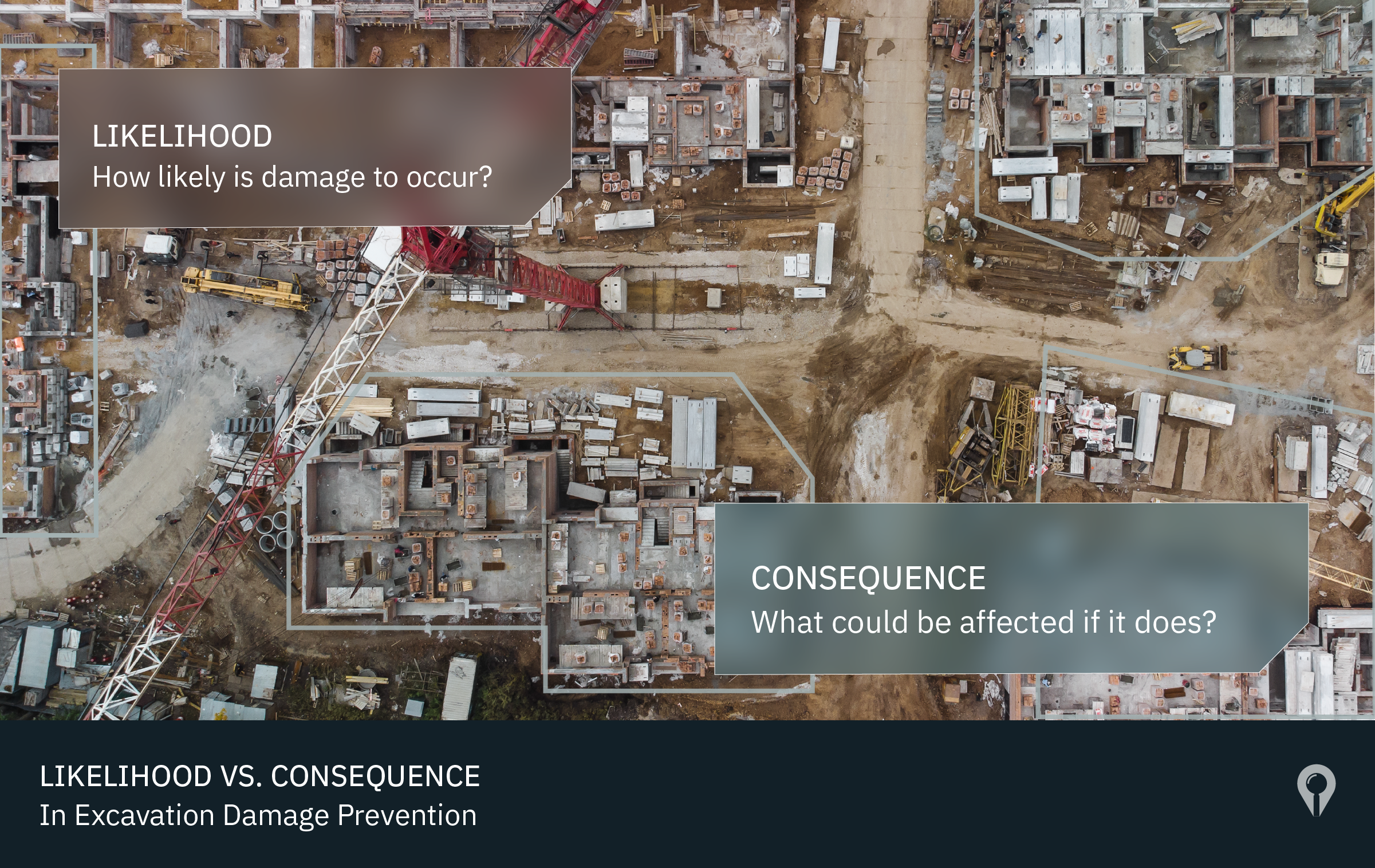
Where would intervention matter most if damage occurred?
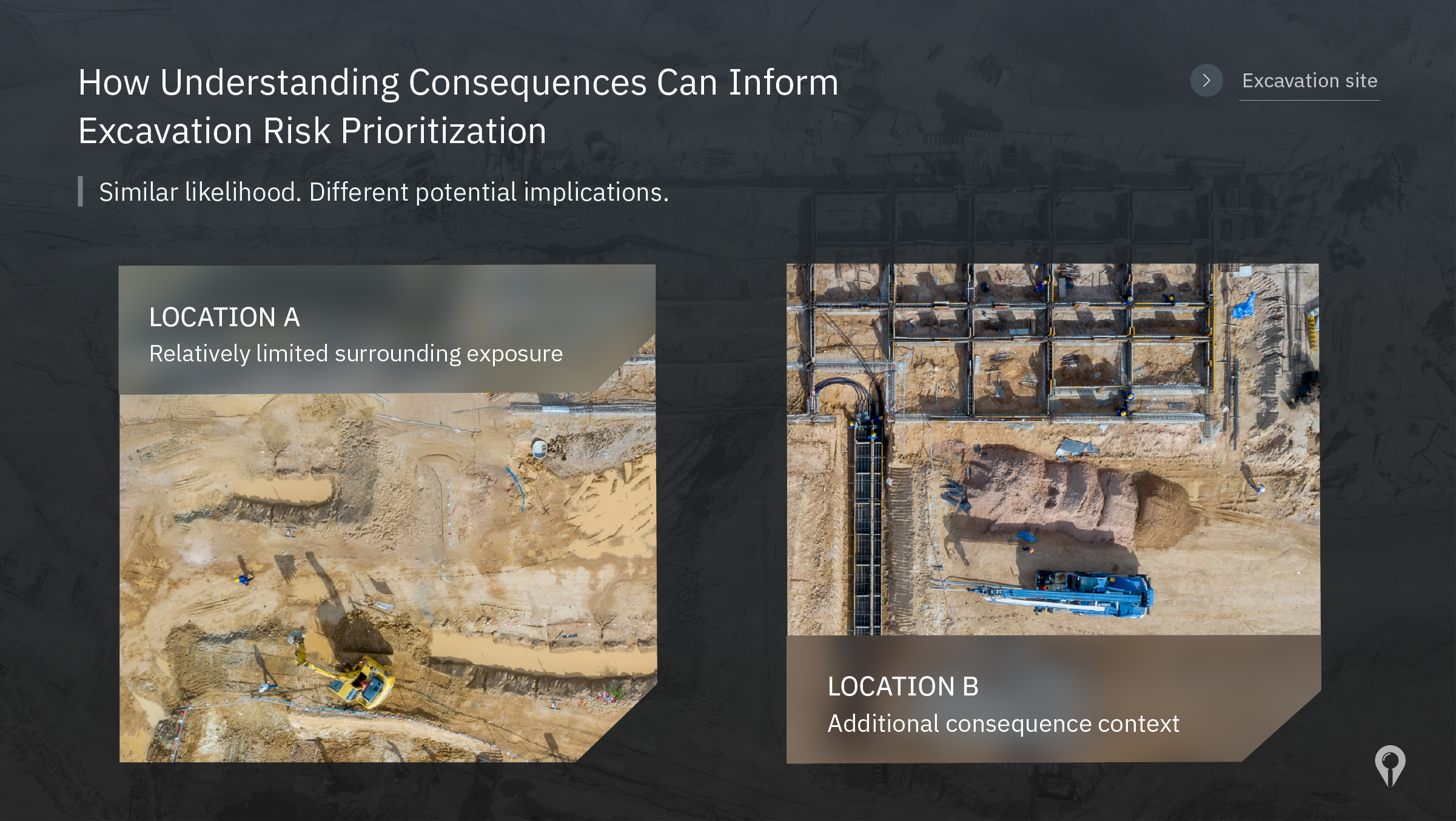
Likelihood provides useful information about where an incident may be more likely. It does not, on its own, resolve every prioritization decision.
The context surrounding excavation activity can vary across a pipeline network. Asset exposure, operating conditions, nearby populations, critical services and potential safety impacts can all influence the potential consequences of damage at a particular location.
For teams working with finite inspection, locating and field resources, this raises another question:
What additional information could change where attention should go first?
That question marks the remaining decision gap. The systems available today can provide increasingly sophisticated information about excavation activity and where risk may warrantattention. Prioritization can still require additional context.
What Additional Context Could Improve Excavation-Damage Prioritization?
Better prioritization can depend on understanding more than the probability of an incident.
The operating and physical context surrounding excavation activity can affect what is at stake at a particular location. Relevant considerations may include asset exposure and criticality, operating conditions, surrounding populations or communities, essential services, and potential operational or safety effects.
Bringing more of that consequence context into the decision can help teams examine where limited intervention resources may warrant closer attention.
The important point at this stage is the decision gap itself: identifying where an incident may be more likely does not necessarily determine where intervention should take priority.
The next question is how that additional context should be understood and incorporated into damage-prevention decisions.
How Could Pipeline Damage Prevention Move From Detection to Prioritization?
The evolution to date can be viewed through four cumulative capabilities:
- 811 and one-call systems provide notification and coordination.
- Digital workflows make excavation activity easier to manage.
- GIS adds spatial and asset context.
Predictive approaches help assess where incidents may be more likely.
Together, these capabilities have strengthened the information available for damage-prevention decisions.
The remaining opportunity is to examine what additional context could help teams decide where finite attention and intervention resources should go when likelihood alone does not resolve the prioritization decision.
The Category Paper frames the next stage of damage prevention as an extension of mature prevention ecosystems, building on the systems and investments already in place.
The direction is evolutionary: use what the industry can already see and assess to support better-informed prioritization.
What Is the Next Question for Pipeline Damage Prevention?
Pipeline damage prevention has become progressively better informed.
Operators have stronger mechanisms for coordinating excavation activity, managing records, understanding spatial context and assessing where incidents may be more likely.
The remaining decision is how those capabilities can help finite resources reach the locations where intervention may matter most.

That question is explored further in KartaSoft's industry discussion paper, Understanding Consequences: Operationalizing Consequences in Pipeline Damage Prevention.
The paper examines the next step in the argument: how consequence context can build on the damage-prevention systems and investments already in place to support more informed prioritization.
Request the Category Paper to explore the full argument.