
Event-aware monitoring for water and wastewater networks
Lower the noise floor in your network telemetry
KartaSoft adds operational event context and physics-informed AI to existing telemetry, helping teams interpret weak signals, reduce low-value investigation, and focus finite resources on the areas with the clearest service, compliance, and capital-risk implications.
Validated in a high-fidelity digital-twin stress test: 1,500-mile topological network, 600 concurrent operational events, five simulated years. Designed for read-only ingestion and passive advisory overlay.
Static threshold struggles when the network keeps moving
| Your network does not operate against a fixed baseline
|
Seasonal demand, weather, industrial consumption, pump station reconfiguration, boundary changes, valve realignments, hydraulic transients, flushing, maintenance windows, and new assets all change what normal looks like. |
|
|
Legacy thresholds and generic models can struggle to keep pace. The result is familiar: more alarms, more uncertainty, more time spent checking signals that do not change the risk conversation, and a greater chance that subtle deterioration stays buried in operational noise. |
|
|
Compliance indicators can be harder to interpret when ordinary operating changes shift the baseline. |
|
|
False positives consume field crew time and distract control-room teams from higher-value review. |
|
|
Alarm fatigue and suppressed alarms create blind spots in day-to-day operations. |
|
|
Over-investigation can redirect maintenance budget away from assets with clearer risk implications. |
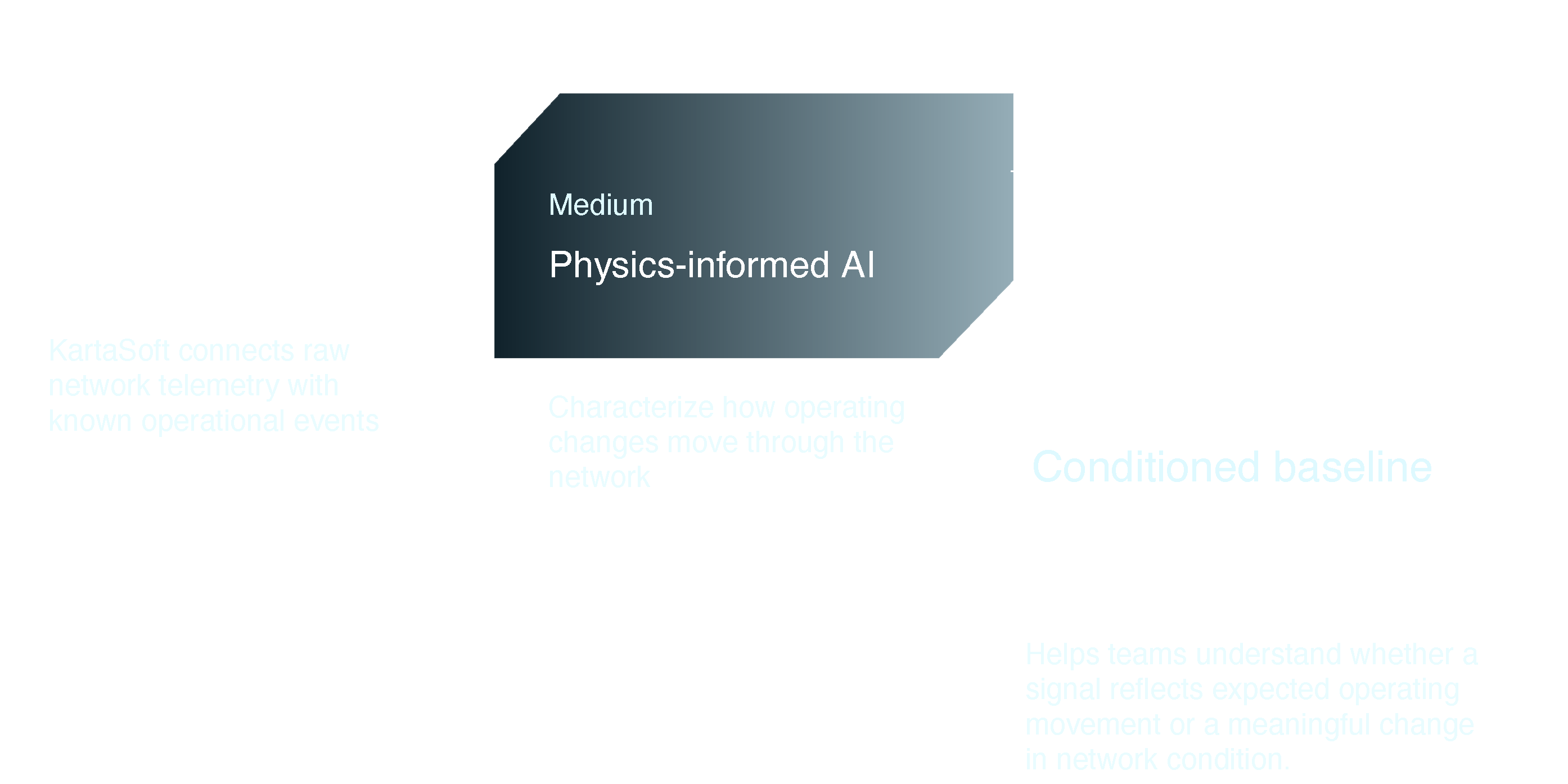
Condition the baseline around real operations
Add context alongside the systems and practices utilities already trust, giving operators and asset teams a clearer view when the network is changing faster than fixed thresholds can keep up. Not replacing SCADA, hydraulic models, field judgment, or governance.
|
Raw, read-only data ingestion. |
|
|
|
Operational event governance for pump changes, valve movements, flushing, demand shifts, maintenance windows, and temporary operating modes. |
|
Dynamic baseline conditioning informed by hydraulic behavior and asset context. |
|
|
Passive advisory overlay for engineering, operations, and capital-planning review. |
Real-World Applications
Rising-main application
Applied to one set of sewage rising mains in a single city, using one utility's data, sparse failure history, uneven data quality, and local climatic, operational, and geotechnical conditions.
Operating Model
Read-only data ingestion, passive advisory overlay, operational event governance, dynamic baseline conditioning, and customer-algorithm validation loop.
How it works?
|
1 Select one high-value network problem |
|
Choose a catchment, pressure zone, pump station group, rising-main corridor, or recurring operating pattern where baseline uncertainty is slowing decisions. |
|
2 Connect event context to telemetry |
|
Coordinate known operating events, telemetry, asset records, work orders, maintenance history, and field context so signal changes can be interpreted with the operating history attached. |
|
3 Condition the baseline with physics-informed AI |
|
Physical model insight guides machine learning so the model is not asked to learn network behavior from raw data alone. |
|
4 Review advisory insights with operators and asset teams |
|
Outputs support situational awareness, maintenance planning, intensified monitoring discussions, and asset management review. |
|
5 Validate the use case |
|
The 12-week recalibration path ties the work back to one defined problem and the KPI selected before the engagement starts. |
Keep baseline aligned with real operations
|
Operational Event Governance |
|
Tag and organize the events that change what normal means: pump cycling, valve changes, flushing, maintenance windows, demand shifts, pressure-zone moves, temporary operating modes, and network expansion. |
|
Dynamic Baseline Conditioning |
|
Refresh the baseline around current conditions so changing operations do not create unnecessary noise or hide weak signals inside routine movement. |
|
Physics-Informed AI |
|
Use physical model insight to guide machine learning in complex utility conditions where sparse failures, uneven data quality, and interacting mechanisms make pure data approaches harder to trust. |
|
Passive Advisory Overlay |
|
Add analytical insight without forcing a replacement conversation. KartaSoft is positioned as additional information for review, not a decision layer. |
FAQs
Keep them. KartaSoft complements existing thresholds, models, and operating practice by adding event context when conditions are changing, failure history is sparse, and multiple mechanisms are interacting.
No. KartaSoft provides additional analytical insight for consideration. Engineering judgment, field practice, and governance remain central.
That is part of the reason to use a physics-informed approach. Our work with customers in predicting rising-main failures involved working with sparse failure history and uneven data quality, then using physical and operational context to support better focus.
Start with one high-value problem, read-only inputs, and a 12-week recalibration pathway. The first conversation can stay tightly scoped to one network area or asset group.
Connect the monitoring conversation to operational efficiency, service reliability, regulatory confidence, maintenance budget focus, non-revenue water, and capital timing evidence.
Outputs are auditable, repeatable, and suitable for regulatory and internal review
Start where telemetry creates the most uncertainty
Bring one catchment, pressure zone, pump station group, rising-main corridor, or recurring operations issue. KartaSoft will show how event-aware monitoring can add context to existing data and support a clearer risk conversation.