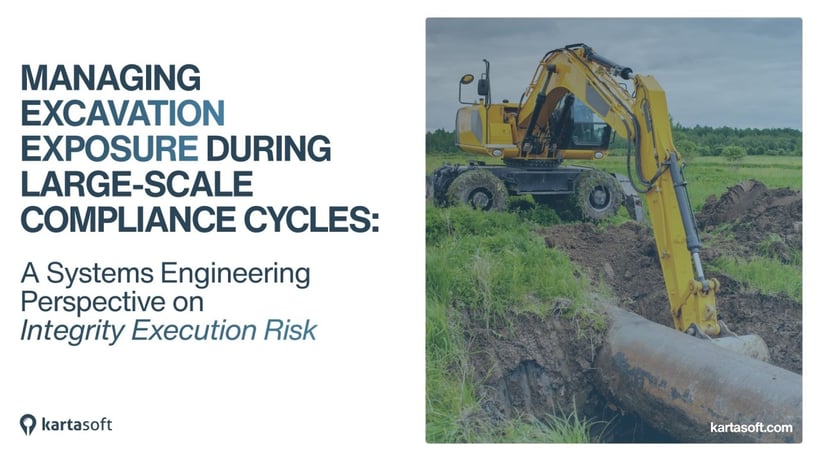
Managing Excavation Exposure During Large-Scale Compliance Cycles: A Systems Engineering Perspective on Integrity Execution Risk
Large-scale compliance programs are designed to reduce long-term pipeline risk. That premise is not in dispute.
However, when compliance requirements trigger substantial increases in field excavation activity, the execution layer itself becomes an operational variable that must be engineered deliberately. It is important to recognize that risk evolves during implementation phases, particularly when physical interaction with buried assets increases.
A recent example is the operational response to federal pipeline safety rulemaking in the United States.
The 2019 Mega Rule and Material Verification
Separately, PHMSA’s 2019 “Mega Rule” amendments to 49 CFR Parts 192 and 195 introduced expanded requirements for:
-
Maximum Allowable Operating Pressure (MAOP) reconfirmation
-
Material property verification
-
Expanded integrity assessment obligations
In cases where historical records are incomplete, operators must physically verify pipeline attributes. For many segments, this cannot be accomplished through documentation or remote inspection alone. Controlled excavation and direct pipe exposure are required.
This is a critical operational reality: some regulatory objectives cannot be satisfied without excavation.
The rule was written precisely because remote methods were deemed insufficient for certain confirmation tasks. Therefore, substitution with inline inspection (ILI) or non-destructive evaluation (NDE) is not always legally or technically permissible.
The Systems Question: Exposure During Compliance Cycles
The systems engineering question is:
How should operators manage aggregate excavation exposure during periods when regulatory compliance materially increases the volume of controlled digs?
There is no evidence that compliance-driven excavation approaches the scale of third-party damage events nationally. Third-party excavation vastly outnumbers operator integrity digs in incident statistics.
However, at the operator level — particularly during peak verification cycles — localized excavation intensity can increase substantially.
Every excavation event, even when controlled, introduces:
-
Human-machine interaction risk
-
Locate precision uncertainty
-
Soil instability variables
-
Coating damage potential
-
Adjacent asset exposure in congested corridors
From a systems perspective, excavation is not risk-neutral simply because it is planned.
It is managed risk.
The “Second-Order Exposure” Concept
Risk temporarily redistributes during execution phases.
Compliance programs reduce long-term integrity uncertainty. That benefit is substantial and measurable.
But during concentrated execution windows, exposure to excavation-related variables increases relative to steady-state operations. This effect is:
-
Localized
-
Temporary
-
Execution-dependent
-
Manageable with appropriate controls
This underscores the need to manage compliance execution as rigorously as operational integrity.
Where This Becomes Operationally Material
The exposure management question becomes more relevant under three conditions:
-
High-density corridors: Multiple operators collocated within narrow rights-of-way increase complexity during any excavation event.
-
Simultaneous large programs: When MAOP reconfirmation, material verification, and unrelated capital projects overlap, excavation intensity compounds.
-
Workforce compression cycles: Construction labor shortages and compressed project schedules elevate execution variability.
In these contexts, excavation exposure is not theoretical. It becomes a planning variable.
Engineering Response: Managing Execution Without Undermining Compliance
The appropriate response is not to slow compliance. It is to optimize its execution.
Disciplined approaches include:
1. Excavation Portfolio Risk Ranking
Not all verification digs carry equal consequences. Exposure modeling should consider:
-
Class location
-
Asset age and vintage
-
Geotechnical instability
-
Corridor congestion
-
Historical damage density
2. Exposure Metrics Alongside Compliance Metrics
Completion counts alone are insufficient. Operators should track:
-
Controlled excavation events per mile
-
Near-miss frequency
-
Coating repair rates
-
Third-party interference proximity
3. Scheduling Discipline in High-Intensity Zones
Avoiding unnecessary concurrency in congested corridors reduces cumulative exposure density during peak execution cycles.
4. Technology Use Within Legal Boundaries
While remote methods cannot replace required verification, advanced analytics and ILI characterization can reduce unnecessary follow-up digs when permitted by regulation.
Industry discussions, including filings by the Interstate Natural Gas Association of America in PHMSA rulemaking dockets, have increasingly referenced the maturation of advanced analytics to support integrity decision-making.
As analytical techniques evolve — including improved anomaly characterization, probabilistic failure modeling, and data integration across integrity datasets — operators are better positioned to:
-
Prioritize higher-consequence verification sites
-
Sequence work to reduce congestion
-
Minimize redundant exposure
-
Allocate field resources more precisely
The objective across these measures is optimization of execution — not substitution for regulatory requirements.
Framing the Balance Correctly
The Mega Rule and Part 196 enforcement structure are designed to strengthen public safety and pipeline integrity. That remains the primary objective.
The systems insight is narrower:
During large-scale compliance cycles, excavation exposure becomes an execution risk variable that should be actively engineered — not passively accepted.
Compliance reduces structural uncertainty. Execution introduces temporary operational exposure.
The task for industry leadership is to minimize the latter while achieving the former.
References
49 CFR Part 196 – Pipeline Damage Prevention Programs https://www.phmsa.dot.gov/pipeline/excavator-final-rule/about-excavation-enforcement-final-rule
PHMSA Docket PHMSA-2025-0019 – Industry Comments Referencing Advanced Analytics (Including INGAA Submissions)
https://downloads.regulations.gov/PHMSA-2025-0019-0022/attachment_1.pdf