Why DRA programs often lose efficiency during changing operating conditions
Reducing Drag Reducing Agent (DRA) spend and protecting throughput usually does not come down to operator intent. In many systems, the bigger issue is execution during changing conditions. Injection strategies that work well in stable operation can become less effective when the pipeline moves through transitions.
Where inefficiency tends to show up
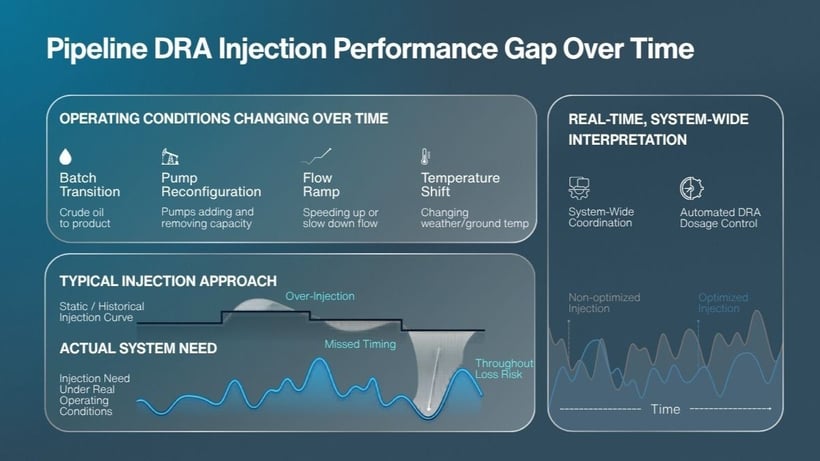
DRA optimization is often built around steady-state assumptions. Those assumptions become less reliable when the system is moving through normal operational variability, such as:
-
Batch transitions across mixed NGL streams
-
Pump starts, stops, or reconfiguration
-
Flow ramps tied to supply variability
-
Temperature changes that alter fluid behavior
These moments are where performance can drift from plan, even when the underlying strategy is sound.
What happens in practice
As operating conditions shift, teams often rely on conservative buffers while older performance curves become less representative of what the system is doing in real time. Over time, that can show up in several ways:
-
Higher injection rates used to protect throughput
-
Lost throughput when injection timing lags changing conditions
-
Static assumptions carried into a system that is behaving dynamically
Why the gap exists
The challenge is usually not a lack of data, and it is rarely a lack of modeling effort. The harder problem is interpreting the full system in real time during transient conditions.
During those periods, operators need decision support that reflects how the pipeline is behaving minute to minute across the network, rather than relying only on historical averages or segment-level assumptions.
A practical way to address it
One approach is to add a physics-informed AI layer that interprets live operating conditions across the system and relates injection decisions to expected pipeline behavior. In practice, that can provide:
-
Continuous adjustment of injection guidance as conditions change
-
System-wide context instead of isolated or averaged signals
-
Actionable outputs that support operations without requiring changes to SCADA or control systems
What that can improve
When transient behavior is handled more accurately, the benefits often appear in familiar operational areas:
-
Lower DRA consumption without increasing operating risk
-
Recovered throughput where timing and outdated curves have become limiting factors
-
More condition-aware, segment-specific injection decisions during change
At its core, this is about making a common source of inefficiency easier to see and manage. Once transient behavior is interpreted in context, DRA execution becomes more consistent with how the system is actually performing.