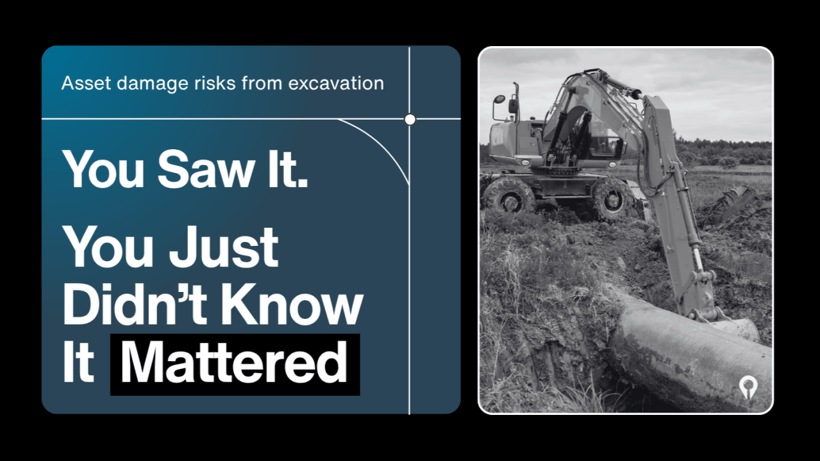
You Saw It. You Just Didn’t Know It Mattered
A patrol goes over a section of a corridor.
There is disturbance. Tracks. Movement.
It is visible.
It is noted.
Though nothing stands out enough to escalate.
There is no ticket, BYDA enquiry, or declared work in the area.
No declared work. No immediate trigger.
So the patrol moves on.
A few days later, the same location becomes an incident.
This is not unusual.
Most people working in damage prevention have seen some version of this before.
The signals are there early.
They just do not always look like risk at the time.
The Reality Most Teams Work Within
Across most networks, there are two primary ways of understanding excavation activity:
1. Locate requests and tickets: Show where work is declared.
2. Patrols and observation: Show what is visible at a point in time.
Both are essential.
Though neither tells the full story.
Where It Starts to Break Down
Ticketing systems depend on third-party behaviour.
They are effective for declared work, though they do not capture everything.
At the same time, patrols and imagery show what can be seen in the moment.
They do not show how activity is evolving over time.
So, what happens?
You get:
→ Strong visibility of declared work
→ Partial visibility of what is actually happening
→ Limited ability to prioritize what matters most
The Signals Are Often Subtle
Early-stage disturbance rarely appears to be an immediate threat.
It might be:
→ A small area of ground movement
→ Vehicle tracks near a corridor
→ Clearing activity that does not appear significant
→ Work that has not yet triggered a ticket
Individually, these do not stand out.
In isolation, they are easy to ignore.
The Problem Is Not Visibility
Most teams are already seeing parts of this.
The issue is not:
Did we see anything?
It is:
Did we recognise that it mattered?
Where Incidents Actually Come From
When you look back at incidents, the pattern is often consistent:
→ The activity was not declared
→ The early signals were visible, though not prioritized
→ The risk did not stand out at an area level
→ It was not clearly linked to network consequence
So, it stayed below the threshold of action.
Until it did not.
A Different Way to Think About It
A single undeclared activity near a high-consequence section of the network can matter more than dozens of compliant tickets elsewhere.
Though most systems do not make that distinction clearly.
They prioritize activity.
Not consequence.
The Real Question
You are probably already seeing more than you think.
The question is:
Do you have a consistent way to identify which of those signals actually create risk?
Why This Matters
Damage prevention has become very good at managing declared work.
That is not where most of the challenge sits.
The challenge lies in:
→ What is not declared
→ What develops over time
→ What does not look important until it is
Closing Thought
Seeing the tracks is not the problem.
Knowing which ones matter, early enough to act, is where things break down.
There is increasing focus on how to connect what is already visible across networks with a clearer understanding of consequence.
→ Not more observation.
→ Not more data.
KartaSoft provides a more consistent way to identify which signals actually matter and act on them before they become incidents.
In the United States, excavation declared work is usually captured through 811 tickets. In Australia, the equivalent process is handled through Before You Dig Australia (BYDA), formerly Dial Before You Dig (DBYD). The underlying issue is the same in both markets: declared work is easier to manage than activity that is visible, developing, and not yet connected to consequence.